
Table of Contents
- Why Custom eLearning Matters for Remote Mining Operations
- How to Estimate eLearning Development Hours Accurately
- Best Practices for Remote Workforce Training in Mining
- Meeting Mining Industry Safety Training Standards
- Designing Custom eLearning That Works Offline and On Mobile
- Measuring Training Impact and Behavioural Change
- Scaling Custom Content Across Distributed Teams
- Frequently Asked Questions
Last Updated: September 2, 2026
Why Custom eLearning Matters for Remote Mining Operations
Remote mining operations face a unique training challenge: teams work across scattered sites with limited connectivity and must master complex safety procedures without in-person instruction. Traditional classroom sessions and printed manuals don’t work when your workforce is dispersed across thousands of kilometres.
Custom eLearning for remote mining teams solves this by delivering training directly to where people work. Rather than pulling workers off-site for days of classroom time, custom modules travel on mobile devices, work offline when internet is patchy, and allow teams to learn at their own pace whilst maintaining operational continuity.
The real value goes beyond convenience. When training content is designed specifically for your mining operation, using scenarios your teams recognise, equipment they actually use, and safety protocols they follow daily, learning sticks. People retain information better because the content speaks their language, and behavioural change follows because training reflects their real working environment.
At Simply eLearning, we’ve worked with mining operations to transform how remote teams learn. The most effective training doesn’t just deliver information; it makes complex topics memorable and actionable. That’s where custom eLearning becomes transformative, it’s not just about ticking a compliance box, it’s about ensuring your people genuinely understand what they’re learning and can apply it safely on site.
The most common mistake mining operations make is treating remote training as a cost-cutting measure. In reality, well-designed custom eLearning actually reduces training costs whilst improving safety outcomes and knowledge retention. The investment pays for itself through fewer incidents, faster onboarding, and reduced downtime.
How to Estimate eLearning Development Hours Accurately
Estimating custom eLearning development time is where many projects go wrong. Quality custom content, especially for safety-critical industries like mining, requires time for research, design, testing, and revision.
A typical custom eLearning module runs 10-15 minutes of learner time (peer-reviewed research). Behind that sits roughly 40-80 hours of development work, depending on complexity (peer-reviewed research). This includes subject matter research, storyboarding, scripting, design, voiceover recording, animation or video production, interactive element coding, and quality assurance testing.
Key variables affecting your timeline:
Complexity of content. A module on basic safety procedures takes less time than one teaching diagnostic troubleshooting or equipment operation. Modules requiring custom video, animation, or interactive simulations demand significantly more hours than text-based modules with static graphics.
Scope of research required. If subject matter experts are readily available and documentation is well-organised, development moves faster. If you’re starting from scattered manuals, outdated procedures, or need to interview multiple experts across different sites, add 20-30% more time.
Number of revisions. Most projects include 2-3 rounds of feedback and revision. Significant changes late in the process multiply hours quickly.
Integration and testing. If your custom eLearning needs to connect with your learning management system, track specific data fields, or work offline on particular devices, technical integration adds hours. Testing across multiple devices and network conditions is non-negotiable for remote mining teams.
Plan 4-6 weeks for a single module, longer for a full course with 5-10 modules. Budget for expert interviews, multiple revision cycles, and thorough testing on the devices and connectivity scenarios your teams actually use.
Underestimating development time is the fastest way to end up with rushed content that looks polished but doesn’t actually teach effectively. Mining safety training especially cannot be rushed. Cutting corners on development hours typically means cutting corners on quality, and that’s where training fails to change behaviour.
Best Practices for Remote Workforce Training in Mining
Remote mining teams need training approaches that acknowledge their reality: limited connectivity, shift-based schedules, and the need to learn without leaving their posts. Generic eLearning designed for office workers will fail.
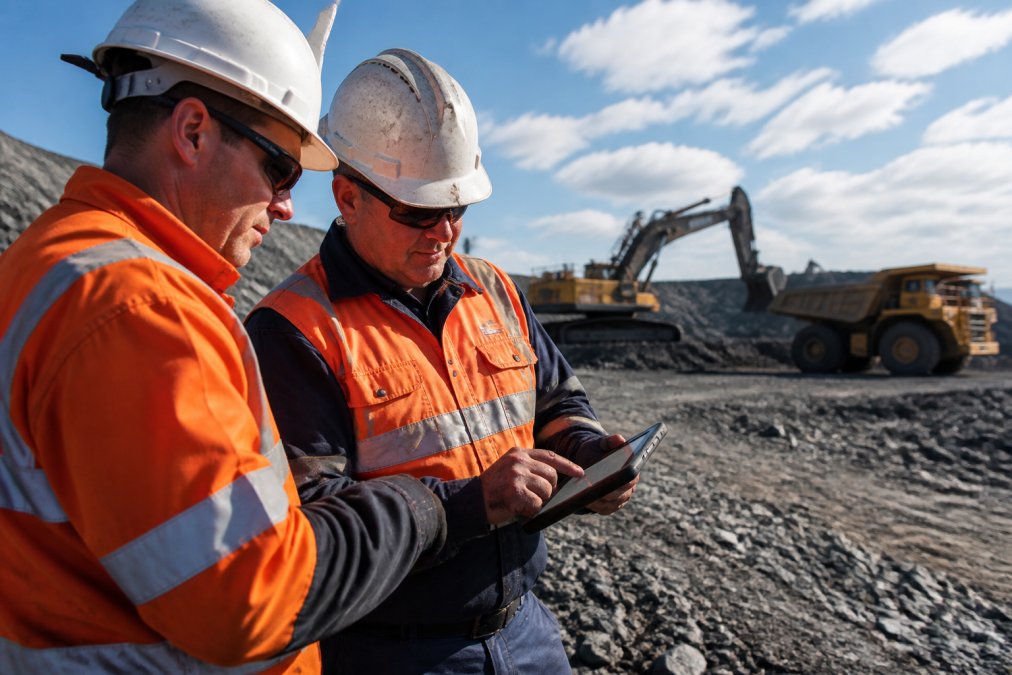
Design for offline-first delivery. Your training content must work without constant internet connection. Modules should download fully, run locally on devices, and sync progress when connectivity returns. This is essential for remote mining operations where connectivity is unreliable.
Prioritise mobile-friendly design. Your teams access training on phones and tablets, not laptops. Content designed for small screens, with touch-friendly interactions and readable text at arm’s length, performs vastly better than content requiring pinch-zooming or horizontal scrolling.
Keep modules short and focused. Remote workers don’t have 45 minutes to sit through a training session. Design modules for 8-12 minutes of active learning. This fits into break times, doesn’t disrupt shift schedules, and matches how people consume content on mobile devices.
Use scenarios your teams recognise. Generic examples don’t land. Custom eLearning works because scenarios show real equipment, real sites, real decisions your teams face. When learners see themselves in the content, engagement and retention jump.
Build in spaced reinforcement. A single training module isn’t enough for behaviour change. Effective remote training includes follow-up content, microlearning reinforcements, or scenario-based refreshers that arrive days or weeks after initial learning. This spacing effect drives real retention.
Test with actual users in actual conditions. Before rollout, have your remote teams use modules on their actual devices, in their actual locations, with their actual connectivity. What works in a test environment with good wifi often fails in the field.
Meeting Mining Industry Safety Training Standards
Mining safety training isn’t optional, and it isn’t generic. Your training must meet requirements set out in relevant Australian workplace health and safety legislation and industry-specific standards. Custom eLearning for remote mining teams needs compliance requirements baked in from the start.
In Australia, mining operations are governed by workplace health and safety laws requiring documented training, competency verification, and evidence that workers understand safety procedures. Your eLearning content must demonstrate that learning has occurred and that workers can apply safety knowledge on site.
Your custom eLearning should include:
Clear learning objectives tied to specific competencies. Specify exactly what workers need to know and do. For example: “Identify four types of ground instability and describe the correct response for each.”
Assessment mechanisms that verify understanding. Scenario-based questions, practical simulations, or knowledge checks requiring workers to demonstrate understanding, not just watch content. Multiple-choice questions where guessing could pass aren’t sufficient for safety-critical training.
Documentation and record-keeping. Your learning management system must track completion, assessment results, and dates. Regulators expect evidence that training was delivered, understood, and kept current. Custom eLearning platforms typically include this audit trail automatically.
Regular review and update cycles. As procedures change, equipment is updated, or incidents reveal gaps in training, your content needs revision. Build in a schedule for annual review and update, at minimum.
Treating safety training as a compliance checkbox rather than a learning opportunity misses the point. The most effective approach combines rigorous compliance with engaging, scenario-based content that actually changes how your teams approach safety on site.
Designing Custom eLearning That Works Offline and On Mobile
The technical architecture of your custom eLearning matters enormously for remote mining teams. Content designed for always-on internet connectivity will fail in the field. You need a platform and design approach built for remote constraints. delivering on-site training.
Offline capability is non-negotiable. Your modules must be downloadable and fully functional without internet. Workers should complete training on a flight, in a remote site with no signal, or during a shift break without waiting for connectivity. The platform should sync progress automatically when the device reconnects.
Mobile-first design, not responsive retrofit. There’s a difference between a desktop module that works on mobile and a module designed for mobile from the ground up. Mobile-first means starting with small-screen constraints, touch interactions, and simplified navigation.
Lightweight file sizes and efficient streaming. Large video files or heavy graphics choke on patchy connections. Optimised video compression, progressive loading, and adaptive bitrate streaming mean content starts playing quickly even on slower connections.
Progressive disclosure and layered information. Rather than overwhelming workers with dense text or long videos, reveal information in layers. A headline, then a tap to expand detail. This approach works better on small screens and keeps cognitive load manageable.
Accessible design for outdoor conditions. Remote mining sites mean bright sunlight, dust, and glare. High-contrast text, larger fonts, and clear audio with captions ensure content is usable in real working conditions.
Testing across actual devices and networks. Before deployment, test modules on the actual phones and tablets your teams use, on the actual network conditions they experience. A module that works perfectly on a new iPhone with 5G might fail on older Android devices with 3G.
Simply eLearning builds custom eLearning specifically designed around these constraints. The architecture supports offline delivery, the design prioritises mobile usability, and testing includes real remote conditions.
The difference between training that works in remote mining and training that doesn’t comes down to one thing: was it designed for remote conditions from the start, or was it designed for office workers and then adapted? Designed-for-remote always wins.
Measuring Training Impact and Behavioural Change
Most training doesn’t change behaviour. People complete modules, pass tests, and then go back to work doing exactly what they did before. The gap between “people know this” and “people do this” is where most training initiatives fail.
Measuring impact means looking beyond completion rates and test scores. Those metrics tell you whether people finished training; they don’t tell you whether training actually changed how people work.
Start with a baseline. Before deploying custom eLearning, measure current behaviour. How many safety incidents occur? How long does a particular task take? How many people follow the correct procedure versus taking shortcuts?
Track leading indicators, not just compliance. Leading indicators are early signals of behaviour change. For safety training, these might include: workers identifying hazards correctly during shift, teams using new procedures without prompting, or reduced near-misses. These appear within weeks of training.
Use on-site observation and spot-checks. Learning management systems tell you who completed training. They don’t tell you whether workers actually apply it on site. Managers observing whether teams use new procedures or running practical assessments reveals whether behaviour has actually shifted.
Gather feedback from teams. Ask workers whether the training was relevant to their job and whether they felt confident applying what they learned. Training that doesn’t resonate with workers rarely changes behaviour.
Measure business outcomes tied to training. Depending on your training focus, this might be: reduction in safety incidents, faster onboarding time, fewer equipment errors, or improved compliance audit results.
Effective behaviour change requires initial learning, reinforcement over time, and ongoing feedback. Custom eLearning for remote mining teams should include follow-up content, refresher modules, and mechanisms for continuous improvement based on how workers actually apply the training.
Scaling Custom Content Across Distributed Teams
Building custom eLearning for one mining site is one challenge. Scaling it across multiple sites, different shifts, and teams with varying experience levels is another.
Modular design enables scaling. Break content into focused modules addressing specific competencies. Modules can be mixed and matched for different team needs. A module on equipment operation applies to multiple sites; a module on site-specific procedures applies to one location.
Centralised content library, decentralised deployment. Store all custom eLearning in one system, but allow different sites or teams to access only what’s relevant to them. Your learning management system should support role-based access, location-based content delivery, or team-specific pathways.
Consistency with local adaptation. Core safety principles should be consistent across all sites. But details, specific equipment models, local hazards, and site-specific protocols will vary. Design your custom eLearning to have a consistent core with adaptable sections.
Asynchronous learning for shift-based teams. If your teams work rotating shifts or different hours, synchronous training won’t work. Custom eLearning’s strength is that workers complete it when it fits their schedule.
Track progress across the distributed workforce. Your learning management system should give you visibility into training completion, assessment results, and knowledge gaps across all sites and teams.
Build in feedback loops for continuous improvement. As teams complete custom eLearning at different sites, gather feedback about what’s working and what isn’t. Use this to refine content, update scenarios, and improve future modules.
Scaling custom eLearning for remote mining teams successfully means treating it as a system. Centralised oversight with distributed delivery, consistent core content with local flexibility, and continuous feedback loops separate scaling projects that work from those that collapse.
Custom eLearning for remote mining teams isn’t a luxury, it’s essential infrastructure for safe, compliant, effective workforce development. Your teams need training designed specifically for remote conditions, built around real mining scenarios, and delivered on devices they actually use.
Simply eLearning specialises in exactly this kind of custom development. We transform complex mining safety and technical content into engaging, mobile-friendly modules that work offline and drive real behavioural change. Our storytelling approach makes mandatory compliance training something teams actually want to complete, and our experience with distributed remote workforces means we build with your constraints in mind from day one. Explore how custom eLearning transforms workforce training outcomes to see how we’ve helped mining and energy operations scale training across dispersed teams without sacrificing quality or safety standards.
Frequently Asked Questions
How does custom eLearning for remote mining teams improve safety compliance?
Custom eLearning tailored to mining operations embeds safety protocols into realistic scenarios that workers encounter on site. Rather than generic compliance modules, bespoke content reflects actual hazards, equipment, and procedures specific to your operation. This approach increases retention and ensures workers can apply learning immediately. Offline functionality means teams access critical safety training regardless of connectivity, and mobile-first design accommodates workers in the field rather than forcing them to a desk.
What makes custom eLearning more effective than off-the-shelf mining training modules?
Off-the-shelf modules treat all mining operations as identical, missing the nuances of your specific workflows, equipment, and team culture. Custom eLearning incorporates your terminology, your processes, and storytelling that resonates with your workforce. Research shows that contextualised, narrative-driven learning produces stronger behavioural change than generic compliance content. Custom solutions also integrate with your existing systems and scale to your team size without degradation.
Can custom eLearning work reliably with poor internet connectivity in remote mining locations?
Yes. Purpose-built custom eLearning for remote teams includes offline-first functionality, allowing workers to download content and complete training without a live connection. Progress syncs when connectivity returns. Mobile-optimised design ensures content works on smartphones and tablets with limited bandwidth. This is essential for mining teams in areas with patchy or unreliable internet, and it removes the frustration of interrupted training sessions.
How long does a custom eLearning project typically take for a mining team?
Timeline depends on scope: the volume of content, complexity of subject matter, number of modules, and your approval processes. Accurate estimation requires understanding your content volume, team size, and delivery deadline. Simply eLearning works within government timelines and compliance requirements to ensure realistic planning.